The Dreyfus Foundation has organized two sessions at the American Chemical Society (ACS) Spring Meeting in Atlanta, Georgia on March 23, 2026. Both sessions will focus on electrochemical processes – the topic of the 2025 Dreyfus Prize. These sessions are open to all attendees of the Meeting.
The distinguished speakers are Héctor D. Abruña (Cornell University), winner of the 2025 Dreyfus Prize, Esther Takeuchi (Stony Brook University), and Gleb Yushin (Georgia Tech).
A reception will follow. Please see below for additional details. For up-to-date information, including how to attend, visit the ACS meeting website.
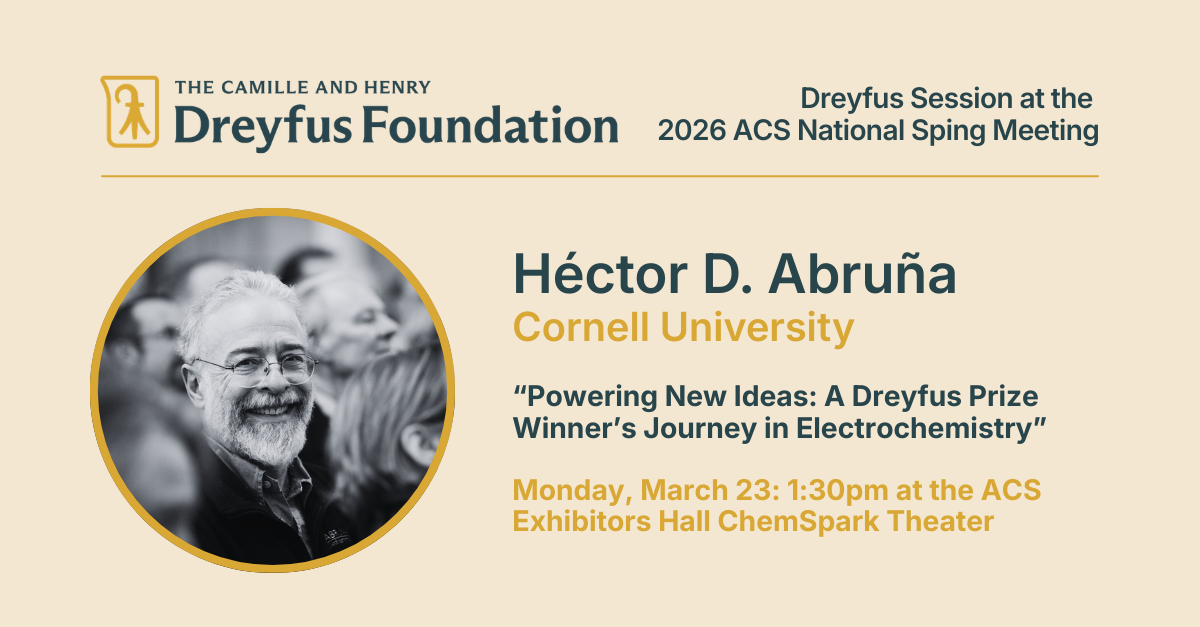
Powering New Ideas: A Dreyfus Prize Winner’s Journey in Electrochemistry
Renowned electrochemist Héctor D. Abruña (“Tito”) reflects on the defining moments that shaped his distinguished career and scientific vision. Born and raised in Puerto Rico, Abruña’s interest in chemistry began early—experimenting with a home “Gilbert” chemistry set, visiting Cornell’s Arecibo Observatory, and accompanying his father, a soil chemist, to the laboratory. Encouraged by devoted teachers, especially his high school chemistry teacher, Bro. Frances Oulette, he set out on a lifelong path in science.
His journey—from Rensselaer Polytechnic Institute to the University of North Carolina at Chapel Hill, postdoctoral work at the University of Texas, a brief (1.5 years) stay at the University of Puerto Rico, and, ultimately, Cornell University, where he has been a faculty member for more than forty years—has been guided by curiosity, persistence, and a drive to connect science with real-world impact.
Now the Émile M. Chamot Professor and Director of the Center for Alkaline-Based Energy Solutions, Abruña’s current work focuses the development and characterization of new materials using a wide variety of techniques, for fuel cells, electrolyzers, and batteries. His enduring commitment to Puerto Rico is reflected in the Abruña Energy Initiative, which is developing and deploying a resilient, hydrogen and battery based grid for Vieques after Hurricane Maria, which devastated Puerto Rico in 2017. He has made mentorship central to his work, shaping the next generation of scientists.
This session, sponsored by the Camille and Henry Dreyfus Foundation and moderated by its President H. Scott Walter and Chair of the Scientific Affairs Committee Milan Mrksich (Northwestern University) will feature a fifteen-minute presentation followed by a thirty-minute audience discussion. Abruña is the 2025 recipient of the Dreyfus Prize in the Chemical Sciences, the Foundation’s highest honor.
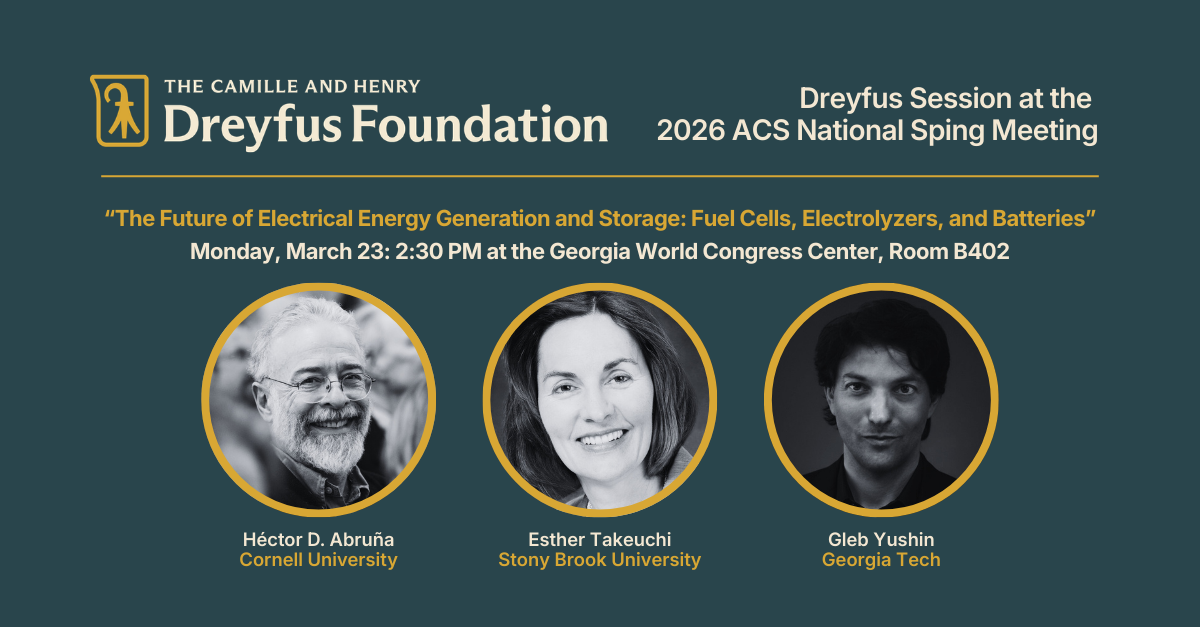
The Future of Electrical Energy Generation and Storage: Fuel Cells, Electrolyzers, and Batteries
What breakthroughs will define the next generation of electrical energy generation and storage? As advances in electrochemistry accelerate, researchers are rethinking how energy is produced, stored, and used—from molecular-scale reactions to grid-scale systems. This session will bring together three pioneering scientists to discuss new advances in fuel cells, electrolyzers, and battery science—from novel materials and smarter designs to longer-lasting systems—that are reshaping clean energy, electric vehicles, portable electronics, biomedical devices, and other technologies that power daily life.
Héctor D. Abruña, Émile M. Chamot Professor at Cornell University, has revolutionized our fundamental understanding of electrochemical interfaces and continues to perform cutting-edge work studying fuel cells, electrolyzers, and battery systems. Esther Takeuchi, William and Jane Knapp Chair of Energy and the Environment at Stony Brook University, invented the lithium–silver vanadium oxide battery that powers implantable medical devices and now leads research in advanced energy storage for health, transportation, and renewable power. Gleb Yushin, Professor at Georgia Tech and co-Founder and CTO of Sila Nanotechnologies, has pioneered synthesis of nanostructured silicon/carbon (Si/C) composites and other nanostructured materials for Li-ion batteries that bypass their macro-scale limitations for world-wide use in clean energy storage, electronics, drones, robots and electric transportation.
This session is sponsored by the Camille and Henry Dreyfus Foundation and inspired by the theme of the 2025 Dreyfus Prize in the Chemical Sciences, Electrochemical Processes, which was awarded to Abruña. It will feature three fifteen-minute presentations followed by an audience discussion, moderated by the Foundation’s Senior Scientific Advisor Matthew Tirrell (University of Chicago) and Board Member Katharine Walter (University of Utah).