The Dreyfus Foundation and ACS Announce Two New Awardees
The American Chemical Society (ACS) recently announced the winners of two Dreyfus Foundation-supported awards aimed at diversity in the chemical sciences as part of their 2027 National Award Winners. Both Awardees will be honored at the ACS Spring 2027 Meeting in New Orleans, LA.
 The 2027 ACS-Dreyfus Award for Encouraging Underrepresented and Economically Disadvantaged Students into Careers in the Chemical Sciences went to Karen S. Molek, Professor and Chair of the Department of Chemistry, University of West Florida. It was given “for leveraging her professional career as a champion who advocates, supports, and empowers students from disadvantaged backgrounds to realize and achieve their academic potential.”
The award – established in 1993 to recognize significant accomplishments by individuals in stimulating students, underrepresented in the profession, to elect careers in the chemical sciences and engineering – consists of $5,000 and a certificate. A grant of $10,000 is also made to an eligible non-profit institution, designated by the recipient, to strengthen its activities in meeting the objectives of the award.
 The 2027 ACS-Dreyfus Award for Encouraging Women into Careers in the Chemical Sciences went to Dr. Judith N. Burstyn, Professor of Chemistry, University of Wisconsin-Madison. It was given “for encouraging women into careers in the chemical sciences – from junior trainees to junior and senior peers at her home institution and far beyond.”
The award – established in 1993 to recognize significant accomplishments by individuals who have stimulated or fostered the interest of women in chemistry, promoting their professional development as chemists or chemical engineers – consists of $5,000 and a certificate. A grant of $10,000 is also made to an eligible non-profit institution, designated by the recipient, to strengthen its activities in meeting the objectives of the award.
Nominations for the 2028 National Awards, including these two Dreyfus Foundation-supported awards, is December 5, 2026. Information on how to submit a nomination can be found on the ACS Website.
Dorothy Dinsmoor Retires from Active Service on the Board of Directors
Dorothy Dinsmoor has retired from active service on the Camille and Henry Dreyfus Foundation’s Board of Directors. Ms. Dinsmoor joined the Foundation in 1987 and held positions as an officer and chair of many committees. She served as Foundation President from 1991 to 2009.
Henry C. Walter, Foundation Board Member and former President (2009-2020), stated: “Dorothy provided the leadership to engage the Foundation in new areas of support and programming. Her thoughtfulness and careful administration of the Foundation will be her legacy.”
Under Ms. Dinsmoor’s direction, the Foundation started new efforts to support faculty, postdoctoral scientists, and undergraduate students; as well as continued the Teacher-Scholar Awards Programs. While her contributions to the Foundation are broad and deep, the inaugural Dreyfus Prize in the Chemical Sciences was made in 2009, her last year as President.
“I recall my first award from the Dreyfus Foundation in 1996 and atop the letterhead was Dorothy Dinsmoor’s name. I met her some years later at a Foundation Symposium in New York City and was struck by her deep appreciation for the impact the Foundation is having to help shape the careers of future leaders in the chemical sciences” said, Dr. Milan Mrksich, Chair of the Foundation’s Scientific Affairs Committee and Henry Wade Rogers Professor of Chemistry, Northwestern University.
Ms. Dinsmoor held executive-level positions at Consolidated Edison in New York City and the Long Island Lighting Company. She served the Church of the Ascension in City of New York as a member of the vestry, as co-chair of the Buildings and Grounds Committee, a member of the Altar Guild and the Acolytes Guild. Ms. Dinsmoor has a degree in art history from Vassar College and a Master of Science in Historic Preservation from Columbia University.
“Dorothy Dinsmoor will be named Director Emerita as of June 1, 2026, said: H. Scott Walter, President of the Dreyfus Foundation. “Dorothy’s wisdom and intelligence was evident in the way she approached the opportunities of keeping the Foundation relevant and effective. Her counsel will be deeply missed.”
Paul Woitach Ends Term on Board of Directors
Paul Woitach’s term on the Camille and Henry Dreyfus Foundation Board of Directors ended in April 2026. Mr. Woitach joined the Foundation’s Board in 2014. Since 2020, Mr. Woitach served as the Vice President of the Foundation and, since 2018, he led the Finance and Audit Committee as Chair.
Mr. Woitach is Managing Partner of Pharmaceutical Advisors, a consulting and staffing firm that provides expert chemistry and biology technical R&D staffing and support to the Pharmaceutical and Biotech industries. He has led teams in supporting 7 biotech New Drug Applications (NDAs) as well as in helping 15 companies to achieve technical success that helped lead to IPOs and acquisitions. Mr. Woitach has more than 35 years in the Life Sciences including as CEO of IGI, VP & GM of Mettler Toledo’s North American Laboratory Instrument business and VP of Marketing Channels with Eastman Kodak’s medical diagnostic imaging business. He has also served on the Boards of public companies and the New Jersey Bioscience Center. Mr. Woitach holds an MBA from the William E. Simon School of Business at the University of Rochester. He has lectured on drug development at the MIT Sloan School, led various courses for ASME, IQPC, and other organizations and has authored various articles for pharmaceutical industry publications.
H. Scott Walter, Foundation President, said: “On behalf of the Board of Directors, I sincerely thank Paul Woitach for over a decade of service to the Foundation, lending his acute expertise to further our mission. We will greatly miss his immense presence and steadfast dedication to advancing the chemical sciences.”
Mr. Woitach commented: “Serving on the Board of Directors of the Dreyfus Foundation has been a great honor. It’s been a privilege to serve with the incredible people that work so hard in support of the Foundation’s mission to advance the science of chemistry, chemical engineering, and related sciences as a means of improving human relations and circumstances throughout the world. I’m looking forward to our world continuing to benefit from their efforts.”

Mr. Woitach (L) presents the 2025 Dreyfus Prize to Héctor D. Abruña (R) at Cornell University.
(Photo credit: Chris Kitchen Photography)
2026 Camille Dreyfus Teacher-Scholar Awards
The Camille and Henry Dreyfus Foundation is pleased to announce the selection of seventeen new Camille Dreyfus Teacher-Scholars for 2026.
The award honors early-career faculty in the chemical sciences who have created an outstanding independent body of scholarship and are deeply committed to education with undergraduates. Each Camille Dreyfus Teacher-Scholar receives an unrestricted research grant of $100,000.
The 2026 winners are:

Ira Caspari-Gnann
Tufts University
The Impact of Instructor Facilitation, Class Design, and Power on In-the-Moment Chemistry Learning
Abdoulaye Djire
Texas A&M University
Designing Lattice-Active MXenes for Electrochemical Catalysis, Separations, and Energy Storage

Austin Evans
University of Florida
Emergent Phenomena in Crystalline and Porous Macromolecular Systems

Matthew Golder
University of Washington
(Re)design & (Re)construction of Plastics: Enhancing Polymer Integrity and Sustainability

Jennifer Hirschi
Binghamton University
Modern Experimental Probes and Theoretical Studies for the Elucidation of Contemporary Catalytic Reactions

Jessica Lamb
University of Minnesota
Harnessing Main-Chain Dipoles in Polymers for Next-Generation Dielectric Materials

Stacy Malaker
Yale University
Cracking the Glycocode through Next-Generation Glycoproteomic Technologies

Emily Mevers
Virginia Polytechnic Institute and State University
Ecology-Driven Natural Product Discovery

Mona Minkara
Northeastern University
Decoding the Molecular Logic of Innate Immune Recognition

Andrés Montoya-Castillo
University of Colorado Boulder
Next Generation Dimensionality Reduction to Predict, Measure, and Manipulate Energy Flow

Grant Rotskoff
Stanford University
Building Thermodynamically Aware Chemical Intelligence

Karthik Shekhar
University of California, Berkeley
The Chemical Physics of Bioelectricity: From Ion Channels to Emergent Excitability

Timothy Su
University of California, Riverside
Molecular Silicon Electronics

Roel Tempelaar
Northwestern University
New Theories of the Optics, Chirality, and Excited-State Dynamics of Materials
Huiliang “Evan” Wang
The University of Texas at Austin
Molecular Engineering of Organic Nanomaterials for Ultrasound-Activated Neuromodulation

Marissa Weichman
Princeton University
Spectroscopy, Dynamics, and Photonic Control of Complex Chemical Systems
Anna Wuttig
University of Chicago
Designing for Disorder in the Electrocatalytic Synthesis of Fuels and Chemicals
2026 Dreyfus Events at the ACS Spring Meeting
The Dreyfus Foundation has organized two sessions at the American Chemical Society (ACS) Spring Meeting in Atlanta, Georgia on March 23, 2026. Both sessions will focus on electrochemical processes – the topic of the 2025 Dreyfus Prize. These sessions are open to all attendees of the Meeting.
The distinguished speakers are Héctor D. Abruña (Cornell University), winner of the 2025 Dreyfus Prize, Esther Takeuchi (Stony Brook University), and Gleb Yushin (Georgia Tech).
A reception will follow. Please see below for additional details. For up-to-date information, including how to attend, visit the ACS meeting website.
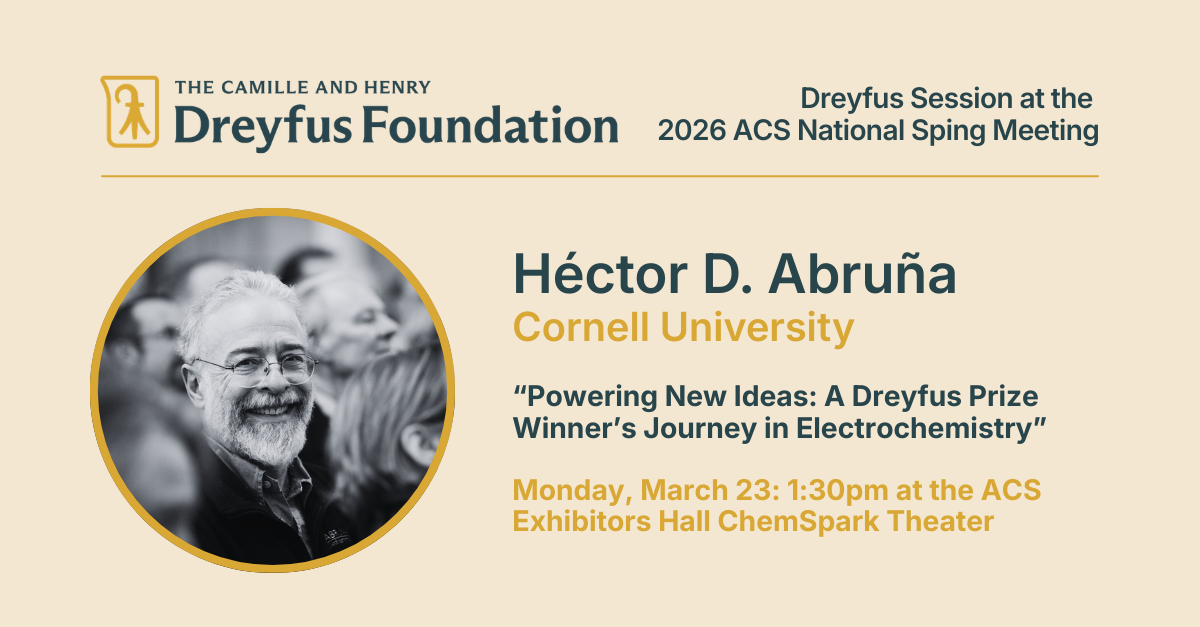
Powering New Ideas: A Dreyfus Prize Winner’s Journey in Electrochemistry
Renowned electrochemist Héctor D. Abruña (“Tito”) reflects on the defining moments that shaped his distinguished career and scientific vision. Born and raised in Puerto Rico, Abruña’s interest in chemistry began early—experimenting with a home “Gilbert” chemistry set, visiting Cornell’s Arecibo Observatory, and accompanying his father, a soil chemist, to the laboratory. Encouraged by devoted teachers, especially his high school chemistry teacher, Bro. Frances Oulette, he set out on a lifelong path in science.
His journey—from Rensselaer Polytechnic Institute to the University of North Carolina at Chapel Hill, postdoctoral work at the University of Texas, a brief (1.5 years) stay at the University of Puerto Rico, and, ultimately, Cornell University, where he has been a faculty member for more than forty years—has been guided by curiosity, persistence, and a drive to connect science with real-world impact.
Now the Émile M. Chamot Professor and Director of the Center for Alkaline-Based Energy Solutions, Abruña’s current work focuses the development and characterization of new materials using a wide variety of techniques, for fuel cells, electrolyzers, and batteries. His enduring commitment to Puerto Rico is reflected in the Abruña Energy Initiative, which is developing and deploying a resilient, hydrogen and battery based grid for Vieques after Hurricane Maria, which devastated Puerto Rico in 2017. He has made mentorship central to his work, shaping the next generation of scientists.
This session, sponsored by the Camille and Henry Dreyfus Foundation and moderated by its President H. Scott Walter and Chair of the Scientific Affairs Committee Milan Mrksich (Northwestern University) will feature a fifteen-minute presentation followed by a thirty-minute audience discussion. Abruña is the 2025 recipient of the Dreyfus Prize in the Chemical Sciences, the Foundation’s highest honor.
The Future of Electrical Energy Generation and Storage: Fuel Cells, Electrolyzers, and Batteries
What breakthroughs will define the next generation of electrical energy generation and storage? As advances in electrochemistry accelerate, researchers are rethinking how energy is produced, stored, and used—from molecular-scale reactions to grid-scale systems. This session will bring together three pioneering scientists to discuss new advances in fuel cells, electrolyzers, and battery science—from novel materials and smarter designs to longer-lasting systems—that are reshaping clean energy, electric vehicles, portable electronics, biomedical devices, and other technologies that power daily life.
Héctor D. Abruña, Émile M. Chamot Professor at Cornell University, has revolutionized our fundamental understanding of electrochemical interfaces and continues to perform cutting-edge work studying fuel cells, electrolyzers, and battery systems. Esther Takeuchi, William and Jane Knapp Chair of Energy and the Environment at Stony Brook University, invented the lithium–silver vanadium oxide battery that powers implantable medical devices and now leads research in advanced energy storage for health, transportation, and renewable power. Gleb Yushin, Professor at Georgia Tech and co-Founder and CTO of Sila Nanotechnologies, has pioneered synthesis of nanostructured silicon/carbon (Si/C) composites and other nanostructured materials for Li-ion batteries that bypass their macro-scale limitations for world-wide use in clean energy storage, electronics, drones, robots and electric transportation.
This session is sponsored by the Camille and Henry Dreyfus Foundation and inspired by the theme of the 2025 Dreyfus Prize in the Chemical Sciences, Electrochemical Processes, which was awarded to Abruña. It will feature three fifteen-minute presentations followed by an audience discussion, moderated by the Foundation’s Senior Scientific Advisor Matthew Tirrell (University of Chicago) and Board Member Katharine Walter (University of Utah).