

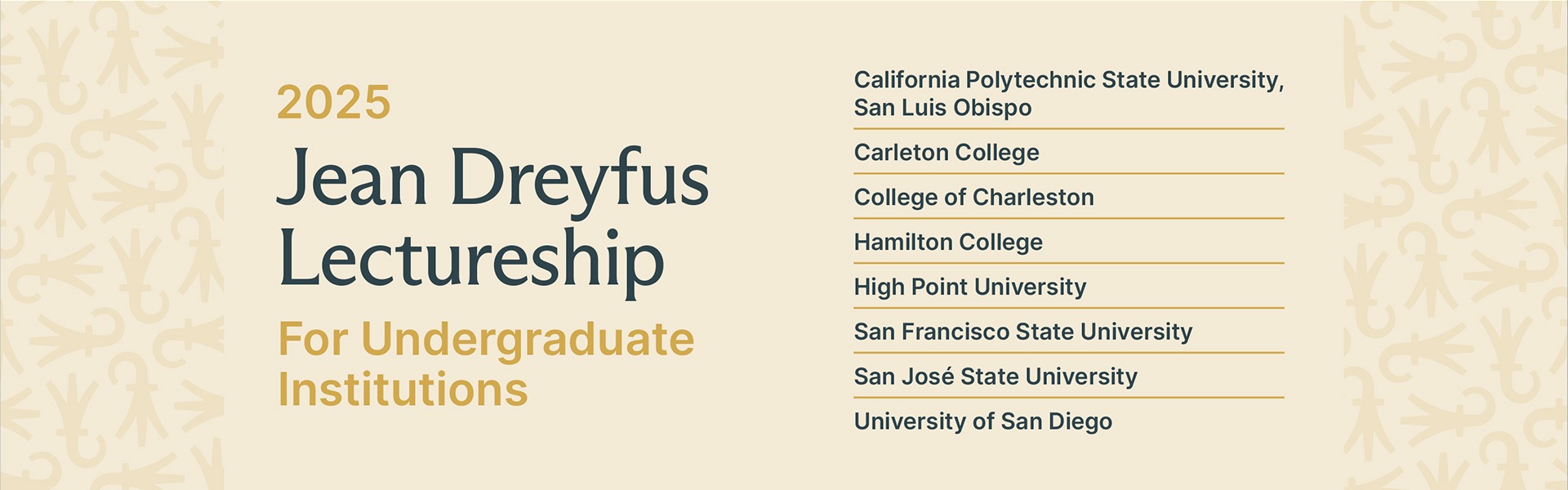
Jean Dreyfus Lectureship for Undergraduate Institutions
Please note that program guidelines were updated on July 1, 2026.
Important Dates
Deadline: August 6, 2026
Announcement: Early November 2026
Overview
The Jean Dreyfus Lectureship for Undergraduate Institutions awards provide a $25,000 grant to 1) facilitate a visit and lectures by a notable researcher in the chemical sciences to a primarily undergraduate institution, and 2) fund summer research fellowships for two undergraduate students.
The visiting researcher must give at least two lectures in the chemical sciences. One of the lectures should be accessible and promoted to a wide audience that includes the general public. The remaining lecture(s) may be more technical. The lecturer is expected to spend more than one day at the institution and to substantively interact with undergraduate students and a range of faculty over the course of the visit. The undergraduates funded to engage in summer research are expected to work with on-campus mentors in the chemical sciences.
Eligibility
- Applications are accepted from departments in the chemical sciences at primarily undergraduate institutions in the States, Districts, and Territories of the United States of America.
- Eligible departments may grant a B.S. or M.S. degree in chemistry or chemical engineering, but not a Ph.D.
- While community colleges are not eligible to be the recipient of this grant directly, we welcome joint applications from PUIs and community colleges where the two institutions share the resources. Please reach out to [email protected] for more information if this is of interest.
- Institutions are restricted to only one application annually for this program.
- Institutions that receive an award are eligible to reapply once all award activities are complete and a satisfactory final report has been submitted.
Applications not selected for funding in past cycles are welcome to reapply by resending their previous proposal with updated information and in accordance with any new guidelines.
Selection
The application is evaluated on the following criteria: The proposed invited lecturer of notability; a detailed schedule for the visit, which is expected to be for a minimum of two days; a description of how the lecturer’s research program would complement departmental activities; the impact of the grant on the institution and larger community; and a description of the department’s efforts in scholarly research and education in the contemporary chemical sciences, including any distinctive educational or outreach efforts. The lecturer must be contacted by the applicant prior to proposal submission to gauge interest and to allow for a better integration of the visit with departmental initiatives.
Applications are reviewed by a panel of distinguished faculty in the chemical sciences. Those recommended for approval are presented to the Foundation’s Board of Directors, and approved awards are announced by early November.
Budget
- The award total is $25,000.
- $2,500 is to support the honorarium for the lecturer.
- $5,000 is to be allocated to the support of the lectures (e.g., travel, accommodation, receptions, dinners).
- $11,000 is to support the summer research of the two undergraduate students. Each student stipend is to be no less than $4,500. The balance may be used to defray costs associated with the research and/or the scientific advancement of each student.
- $1,500 is to support research supplies for the named summer students.
- $5,000 is to support the PI’s summer salary.
- Charges associated with indirect costs or institutional overhead are not allowed.
Application Procedure
All materials must be received at the Foundation office by the deadline.
If you have any questions about the application process, or would like to discuss best practices with a member of the Foundation’s team, please reach out to [email protected]. The Foundation especially encourages institutions new to the award process to reach out for a discussion. Also note our new FAQ section below, which answers many commonly asked questions.
The body of the application is limited to nine pages (including the online application form). A required appendix is also requested, the length of which is determined by the number of faculty members.
The body of the application (nine pages) consists of:
- The online application form
- A brief introduction to the department, including a tabulation of the number of senior chemistry or chemical engineering majors in each of the past five years and the number of whom go on to graduate school in the chemical sciences
- A description of undergraduate involvement in research
- An explanation of the one proposed lecturer (who must be contacted in advance) and topic(s) to be discussed
- A detailed justification as to why the lecturer and topic(s) will integrate into ongoing departmental interests
- A description of why this grant would be impactful to the faculty, students, and larger community
- A proposed full schedule of the two required lectures and other activities that demonstrates broad engagement of the lecturer with students and faculty
- A brief description of the process to select the undergraduate research students
- A simple budget describing how award funds are anticipated to be used
The required appendix consists of:
A listing of the department faculty with their educational backgrounds and year of appointment in the department cited; a brief description of their research programs; a list of three representative research publications for each, with undergraduate coauthors indicated; and a list of current and recent external support for each, with award years and amounts indicated. As a guideline, each faculty member should be limited to no more than half a page.
Send all above materials as one PDF to: [email protected].
Frequently Asked Questions
- What type of lecturer should be selected?
The lecturer should have a direct connection to departmental research interests – the benefit of which should be clearly demonstrated in the proposal. We encourage applicants to think creatively about who would make the most impact at their institution. They must be contacted in advance, to ensure availability and willingness to participate. Applicants should select a distinguished senior researcher in the chemical sciences who, without the funding provided by this grant, would be unlikely to make a visit to the institution. For inspiration on the caliber of researcher(s) to select, please see the lists of past Jean Dreyfus Lectureship grantees and lecturers. Our list of Camille Dreyfus Teacher-Scholars and Henry Dreyfus Teacher-Scholars may also be helpful.- What types of activities should be included in the schedule?
The visit must occur over a minimum of two days and include two lectures – one of which must be on a topic of more general interest and open to the general public. While we allow and encourage creative thinking surrounding additional programming, examples of past activities include: meals with students and faculty, one-on-one meetings with faculty, participation in poster sessions, guest lectures, involvement in seminars, meetings with student-led groups, etc.- Are two PIs allowed?
Two PIs are permitted, but only one primary contact can be listed on the cover sheet. The other PI can be mentioned in the body of the proposal.- Does the PI need to be the student mentor?
It is not required that the PI is a student research mentor, but they may be.- When will the cover sheet generator be available?
The Foundation opens the generator approximately three months prior to the deadline each year.- Which faculty members should be included in the listing of the department faculty?
This appendix is meant to give reviewers a sense of what the department looks like. The Foundation encourages applicants to list all faculty members, both tenure-track and lecturers, in the appendix.- Who receives the summer salary?
The Foundation allows the PI of the grant, the student mentors, the event organizers, or a combination of any of those faculty members to receive a portion of the summer salary.- How should the summer research experience be structured?
Many applicants choose to use funds to add additional students to existing summer research programs. A new program is not needed for these students.- How long do grantees have for the expenditure of funds and completion of activities?
The Foundation allows three years for the expenditure of funds and completion of activities.- Who should send the proposal to the Foundation?
The Foundation does not have a requirement for who sends the proposal. However, it is strongly recommended that the PI and institutional contact are copied on the email to ensure everyone is aware the proposal has been submitted and to quickly assist with any possible issues.- Are there any formatting requirements?
While the Foundation does not have any formatting requirements, it is expected that applicants use a reasonable font size for reading and printable margins.
Reports
Reports are due after the lectureship and undergraduate research are complete.
Lectureship Report:
A description of the lectureship, including:
- Titles of the lectures
- Photographs and/or links to video footage (with crediting information, if they can be shared)
- Promotional materials and any news items, articles, and/or social media posts about the event
- Audiences invited and approximate attendance
- A description of the lecturer’s engagement in departmental activities
Undergraduate Research Report:
A description of the student research, including:
- A description of the research activities
- A brief discussion of the students’ future plans
- The curricula vitae of the mentors
Financial Report:
A full accounting of expenditures, including clearly marked line items for:
- The amount of Dreyfus Foundation funds received
- The amount of Dreyfus Foundation funds spent
- The amount of Dreyfus Foundation funds remaining
Please send all three parts as a single PDF to: [email protected]. We would greatly appreciate photos being sent as separate files.
Additional information
- Publications and presentations describing research supported by the award should acknowledge The Camille and Henry Dreyfus Foundation.
- Procedural questions may be directed to the Foundation office by e-mail at [email protected] or by telephone at 212-753-1760.
Jean Dreyfus
Jean Dreyfus was President of the Camille and Henry Dreyfus Foundation from 1956 until her death in 1991. Born in Chicago, she was married to Camille Dreyfus, founder and chairman of the Celanese Corporation of America and of the Camille and Henry Dreyfus Foundation, from 1931 until his death in 1956.
A renowned operatic soprano and patron of the arts, she sang as Jean Tennyson with several leading European and American opera companies, including La Scala in Milan, the Chicago Civic Opera, and the San Francisco Opera Company. She also sang on the CBS Radio program “Great Moments in Music” from 1942 to 1946.
After World War II, Mrs. Dreyfus founded the Artists Veterans’ Hospital Programs of the Musicians Emergency Fund, which presented concerts for patients in veterans hospitals. She also served as a patron of the Philharmonic Society of New York and as vice chair of New York City’s Lewisohn Stadium Concerts. She was a trustee of the New York City Opera and a principal supporter of the Spoleto Festival.
Mrs. Dreyfus received several awards, including the Stella della Solidarieta from the Italian government, the St. Olaf Medal from the King of Norway, and an honorary Doctor of Humane Letters from the University of Vermont.