


Dreyfus Teacher-Scholar Symposium, 2024
The biennial symposium for Camille and Henry Dreyfus Teacher-Scholars was held at premier life sciences space Cure in New York City on October 18, 2024. Recent Teacher-Scholars presented posters of their research and heard scientific talks by distinguished senior scientists and a panel discussion on “Successful Navigation from Early-Career to Mid-Career.”
The speakers were: Louis E. Brus (Columbia University), Moungi Bawendi (MIT), Marilyne Stains (University of Virginia), Alex Dainis (Chemistry Shorts®), Mark Wrighton (George Washington University & Washington University in St. Louis), and Cato T. Laurencin (University of Connecticut).
The panelists were: Eray Aydil (NYU), Luis Campos (Columbia), Sharon Hammes-Schiffer (Princeton), and Marc Zimmer (Connecticut College).
SPEAKER TALKS, BIOS, AND PHOTOS
“The Discovery and Synthesis of Quantum Dots, Part A”
Brus is an American physical chemist who was awarded the 2023 Nobel Prize in Chemistry for his work in discovering and producing quantum dots, which are very small particles whose unusual quantum properties depend on their size. He shared the prize with Russian-born American physicist Alexei Ekimov and French-born American chemist Moungi Bawendi. He completed his bachelor’s degree in chemical physics in 1965. After graduation, he was able to delay his active service in the United States Navy to complete a Ph.D. degree in chemical physics. Upon his graduation in 1969, he was made a lieutenant and stationed in Washington, D.C., as a science staff officer at the United States Naval Research Laboratory. After his service was completed in 1973, he served as a research technician at AT&T Bell Laboratories in Murray Hill, New Jersey, where he began to experiment with nanocrystals and semiconducting materials. Brus remained at Bell Laboratories until he joined the chemistry faculty at Columbia University in 1996. There he served as the scientific head of the complex films research group at the National Science Foundation’s Materials Research Science and Engineering Center from 1998 to 2008 and as codirector of the U.S. Department of Energy’s Energy Frontiers Research Center from 2009 to 2014.
Brus became an elected fellow of the American Physical Society in 1980 and of the American Academy of Arts and Sciences in 1998, and he was elected to the United States National Academy of Sciences in 2004. He was the recipient of the American Chemical Society’s Chemistry of Materials Prize in 2005 and of the Kavli Prize in Nanoscience in 2008. Brus shared the R.W. Wood Prize of the Optical Society of America (OSA, now Optica) with Russian scientist Alexander L. Efros and Ekimov in 2006 for their work with quantum dots. In addition, Brus received the National Academy of Sciences Award in Chemical Sciences in 2010.

“The Discovery and Synthesis of Quantum Dots, Part B”
Bawendi is the Lester Wolfe Professor of Chemistry at MIT and Advisor for the Minor in Energy Studies, MIT Energy Initiative. He Is a French-born American chemist who was awarded the 2023 Nobel Prize for Chemistry along with Brus and Ekimov. Bawendi was a postdoctoral fellow under Brus in the late 1980s, and later, as a professor at MIT, he developed a method for producing high-quality quantum dots of a consistent size. Today quantum dots are used in many applications, including in QLED (quantum-dot light-emitting diode) screens, in solar cells, and as markers in biomedical imaging. Bawendi earned a bachelor’s degree in 1982 and a master’s degree in 1983 from Harvard University. He attended the University of Chicago for graduate studies and received a Ph.D. degree in 1988. He subsequently joined Bell Laboratories as a postdoctoral fellow. There he worked under the guidance of Brus, researching photo-physics and basic concepts in materials synthesis that were fundamental to advancing methods of producing high-quality nanoparticles and quantum dots. In 1990 Bawendi accepted a position at MIT where he became a full professor in 1996. Awards and honors include the Sloan Research Fellowship in 1994, the 1997 Nobel Signature Award for Graduate Education in Chemistry of American Chemical Society, the 2001 Sackler Prize in Physical Chemistry of Advanced Materials, and election to the National Academy of Sciences in 2007.
The Bawendi Lab’s research ranges from the very fundamental to applications in electro-optics and biology. There is an ongoing synthetic effort underlying all of this to address the challenges of making new compositions and morphologies of nanocrystals and nanocrystal heterostructures, and new ligands so that the nanocrystals can be incorporated into hybrid organic/inorganic devices, or biological systems.
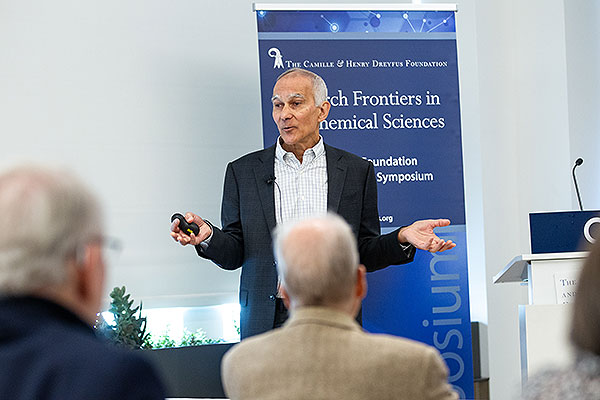
“Embodying Your Teacher-Scholar Identity”
Stains is a Professor of Chemistry at the University of Virginia. She received her B. S. from Université des Sciences de Luminy, Marseille, France in 2001, her M. S. from Université Paul Sabatier, Toulouse, France in 2002 and her Ph. D. from the University of Arizona in 2007. She completed her postdoctoral research at the University of Massachusetts. She started her academic career at the University of Nebraska-Lincoln in 2011 and was promoted to Associate professor with tenure in 2016. Stains joined the Department of Chemistry at the University of Virginia in August 2019 and was promoted to full professor in 2022. Awards and honors include PECASE in 2019, ACS Women Chemists Committee Rising Star award in 2019, and NSF CAREER award in 2016. Stains’ work has been published in Science, CBE- Life Sciences Education, and the Journal of Chemical Education.
Her research group focuses on closing the gap between research and practice in the teaching of science courses at the postsecondary level. As discipline-based education researchers (DBER), they are specifically interested in developing new methods to characterize instructional practices in STEM college classrooms, exploring how faculty and teaching assistants think about their teaching, identifying individual, departmental, and institutional factors that influence instructors’ instructional decisions, and characterizing the impact of different types of pedagogical professional development programs.

“Communicating Chemistry”
Dainis is a freelance science communicator and video producer with seven years of experience producing digital, educational content for the web. Her background includes a PhD in genetics from Stanford University as well as ten years of experience producing visual and interactive media. She was additionally honored to be a 2019 Jackson Wild Media Lab Fellow.
Now based in Los Angeles, CA, her focus is on bringing humanity and storytelling to science via online media. She formed Helicase Media LLC to serve as a science communication and video production company that meets all aspects of her clients’ needs for accurate media that is as compelling as it is illuminating.

“Leadership from the Perspective of a University President”
Wrighton is the James and Mary Wertsch Distinguished University Professor and Chancellor Emeritus at Washington University in St. Louis. Wrighton earned his BS degree with honors in chemistry from Florida State University in 1969. He did his graduate work at the California Institute of Technology (Caltech) under Professors Harry B. Gray and George S. Hammond, receiving his PhD in 1972. Based on his research accomplishments as a PhD student, Wrighton was named the first recipient of the Herbert Newby McCoy Award at Caltech. Wrighton started his career at MIT in 1972 as assistant professor of chemistry. He was appointed associate professor in 1976 and professor in 1977. From 1981 until 1989 he held the Frederick G. Keyes Chair in Chemistry. In 1989 he was appointed the first holder of the Ciba-Geigy Chair in Chemistry. He was Head of the Department of Chemistry from 1987-90 and became Provost of MIT in 1990, a post he held until the summer of 1995. In July 1995, Wrighton became the 14th chancellor and chief executive officer of Washington University in St. Louis, a position he held for almost 24 years.
Wrighton serves on the Board of Directors of Corning Incorporated, Forest Park Forever, and is Chairman of the St. Louis Science Center’s Board of Commissioners and the Center for Civic Research and Innovation. He also serves as: an Honorary Emeritus Trustee of Washington University in St. Louis; a Trustee of Concordance and the Institute of International Education; and he is a Life Member Emeritus of the Corporation of the Massachusetts Institute of Technology. Wrighton is the author or co-author of more than 300 articles published in professional and scholarly journals, and he holds 16 patents.

“Regenerative Engineering”
Laurencin is the University Professor and Albert and Wilda Van Dusen Distinguished Endowed Professor of Orthopaedic Surgery at the University of Connecticut. He is Professor of Chemical Engineering, Professor of Materials Science and Engineering and Professor of Biomedical Engineering at the school. He serves as the Chief Executive Officer of The Connecticut Convergence Institute for Translation in Regenerative Engineering and the Director of the Raymond and Beverly Sackler Center for Biomedical, Biological, Physical and Engineering Sciences at UConn. Dr. Laurencin earned a B.S.E. in Chemical Engineering from Princeton University, and his M.D., Magna Cum Laude, from the Harvard Medical School, and received the Robinson Award for Surgery. He earned his Ph.D. in Biochemical Engineering/Biotechnology from the Massachusetts Institute of Technology where he was named a Hugh Hampton Young Fellow. A practicing sports medicine and shoulder surgeon, Dr. Laurencin has been named to America’s Top Doctors for over fifteen years. He is a Fellow of the American Academy of Orthopaedic Surgeons, a Fellow of the American Orthopaedic Association, a Fellow of the American College of Surgeons and a member of the American Surgical Association. He received the Nicolas Andry Award, the highest honor of the Association of Bone and Joint Surgeons, and the Kappa Delta Ann Doner Vaughn Award from the American Academy of Orthopaedic Surgeons. Dr. Laurencin served as Dean of the Medical School and Vice President for Health Affairs at the University of Connecticut.
He received the Founder’s Award (highest award) from the Society for Biomaterials, the Von Hippel Award (highest award) from the Materials Research Society and the James Bailey Award (highest award) from the Society for Biological Engineering. He received the NIH Director’s Pioneer Award, NIH’s highest and most prestigious research award, for his new field of Regenerative Engineering and the National Science Foundation’s Emerging Frontiers in Research and Innovation Grant Award. Dr. Laurencin is the Editor-in-Chief of Regenerative Engineering and Translational Medicine, published by Springer Nature, and is the Founder of the Regenerative Engineering Society. He is a Fellow of the American Chemical Society, a Fellow of the American Institute of Chemical Engineers, a Fellow of the Biomedical Engineering Society, a Fellow of the Materials Research Society, an AAAS Fellow, an elected member of the National Academy of Sciences, an elected member of the National Academy of Engineering, an elected member of the National Academy of Medicine, and an elected fellow of the National Academy of Inventors. The American Association for the Advancement of Science awarded Dr. Laurencin the Philip Hauge Abelson Prize given ‘for signal contributions to the advancement of science in the United States’.

PANELIST BIOS AND PHOTOS
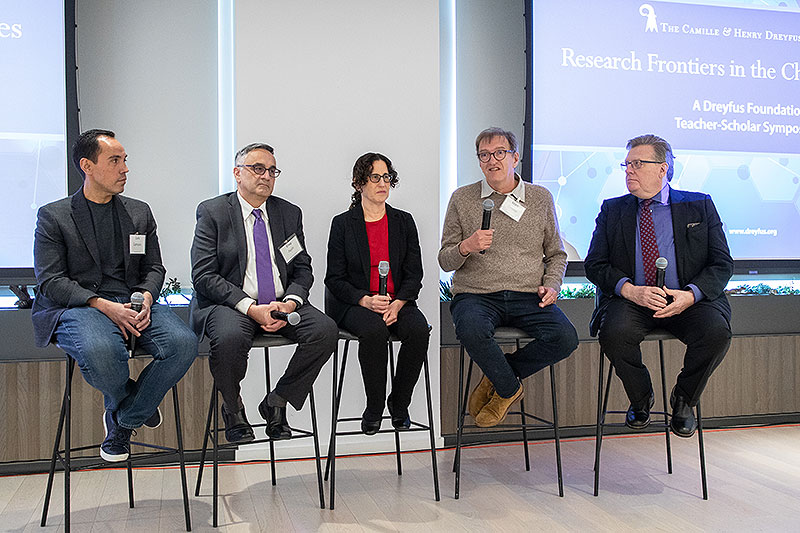
Aydil is the Interim Dean and Senior Vice Dean of the NYU Tandon School of Engineering, and the Alstadt Lord Mark Professor of Chemical and Biomolecular Engineering at New York University Tandon School of Engineering. Previously he was the Ronald L. and Janet A. Christenson Chair in Renewable Energy and Executive Officer of the Department of Chemical Engineering and Materials Science at the University of Minnesota. He is a Fellow of the American Vacuum Society and Editor-in-Chief of the Journal of Vacuum Science and Technology. He received his B.S. degrees in chemical engineering and in materials science and engineering, both from U. C. Berkeley in 1986. He received his Ph.D. degree in chemical engineering in 1991 from the University of Houston. He was a postdoc at Bell Labs until 1993 when he joined the faculty of the chemical engineering department at U.C. Santa Barbara as an assistant professor. By the time he left U.C. Santa Barbara in 2005 for University of Minnesota, he was a full professor and vice chairperson. In 2005, Dr. Aydil joined the Department of Chemical Engineering and Materials Science (CEMS) at the University of Minnesota where he remained until 2018; between 2009 and 2014 he served as the Executive Officer of CEMS. In 2018 he moved to New York University Tandon School of Engineering. He has published over 200 articles and holds seven patents. His research group is interested in electronic, optoelectronic, magnetic, and catalytic materials synthesis and characterization with an emphasis on understanding synthesis-structure-property-performance relations.
In recognition of his research, he has received the Peter Mark Award and the Plasma Prize from the American Vacuum Society, the Norman Hackerman Young Author Award of the Electrochemical Society and the National Young Investigator Award of the National Science Foundation.
Campos is a Professor in the Department of Chemistry at Columbia University. Luis grew up in Guadalajara, Mexico, and moved at the age of eleven to Los Angeles, California. He received a B.Sc. in Chemistry from CSU Dominguez Hills in 2001, and a Ph.D. from the Department of Chemistry & Biochemistry at UCLA in 2006 working under the supervision of M. A. Garcia-Garibay and K. N. Houk. At UCLA, he was awarded the NSF Predoctoral Fellowship, Paul & Daisy Soros Fellowship, and the Saul & Silvia Winstein Award for his graduate research in solid-state photochemistry. Switching to materials chemistry, he went to UCSB as a UC President’s Postdoctoral Fellow to work under the supervision of C. J. Hawker at the Materials Research Laboratory. At Columbia, his group’s research interests lie in physical macromolecular chemistry, and in exploiting nanostructured materials for the development of advanced functional systems. Luis is currently an Associate Editor for Chemical Science.
He has co-authored over 100 articles and 21 patents; and he has received various awards, including the PECASE, ACS Arthur C. Cope Scholar Award, ONR Young Investigator Award, NSF CAREER Award, and the Herman F. Mark Scholar Award, among others. In addition to these research accolades, Luis has been recognized for his pedagogical contributions by the Cottrell Scholar Award and Columbia University Presidential Teaching Award.
Hammes-Schiffer is the A. Barton Hepburn Professor of Chemistry at Princeton University. She received her B.A. in 1988 from Princeton and her Ph.D. in Chemistry from Stanford University in 1993, followed by two years at AT&T Bell Laboratories as a postdoctoral research scientist. She was the Clare Boothe Luce Assistant Professor of Chemistry and Biochemistry at the University of Notre Dame from 1995-2000 and spent the next twelve years at The Pennsylvania State University, initially as the Shaffer Associate Professor of Chemistry and later as the Eberly Professor of Biotechnology. She became the Swanlund Chair and Professor of Chemistry at the University of Illinois at Urbana-Champaign in 2012 and the John Gamble Kirkwood Professor of Chemistry at Yale University in 2018. She has been Chair of the Physical Division of the American Chemical Society, Deputy Editor for the Journal of Physical Chemistry B, and a member of the Basic Energy Sciences Advisory Committee for the Department of Energy. Currently, she serves as editor-in-chief of Chemical Reviews. Her research group focuses on the development and application of theoretical and computational methods to understand the fundamental physical principles underlying chemical processes. One of the lab’s main interests is proton-coupled electron transfer (PCET) reactions, which involve the coupled motions of electrons and protons and play a critical role throughout chemistry and biology. More generally, their research encompasses charge transfer and catalysis in molecular, electrochemical, photochemical, and biological systems. In addition to her research activities, Dr. Hammes-Schiffer is the co-author of a textbook entitled Physical Chemistry for the Biological Sciences, Second Edition.
Awards include a 1996 NSF CAREER Award, 1998 Alfred P. Sloan Research Fellowship, 2005 International Academy of Quantum Molecular Science Medal, 2011 NIH MERIT Award, 2020 Royal Society of Chemistry Bourke Award, 2020-21 Joseph O. Hirschfelder Prize in Theoretical Chemistry, and 2021 ACS Award in Theoretical Chemistry.
Zimmer is the Jean C. Tempel ’65 Professor of Chemistry at Connecticut College. He received his B.S. and M.S. from University of Witwatersrand, South Africa and his Ph.D. from Worcester Polytechnic Institute, and he completed his Post-Doctorate at Yale University. He teaches general chemistry, molecular science and environmental chemistry. Zimmer’s book, Glowing Genes: A Revolution in Biotechnology is the first popular science book on jellyfish and firefly proteins, which can help fight cancer, create new products, improve agriculture and combat terrorism. The book presents an overview of the many uses of these glowing proteins to kill and image cancer cells, monitor bacterial infections and light up in the presence of pollution. His other books include Illuminating Disease, Bioluminescence: Nature and Science at Work, and Lighting Up the Brain: The Science of Optogenetics. Zimmer’s research group is mainly interested in the structural and photophysical properties of Green Fluorescent Protein (GFP), a protein found in jellyfish that has found numerous uses as a marker in medicine, cell biology and molecular biology. This work is funded by the National Institute of Health and the Research Corporation.
In 2007, Professor Zimmer was named the Connecticut Professor of the Year by the Council for Advancement and Support of Education (CASE) and the Carnegie Foundation for the Advancement of Teaching. He received the College’s 2001 John S. King Memorial Award to recognize excellence in teaching and the College’s 2005 Nancy Batson Nisbet Rash Faculty Research Award for outstanding scholarly achievement.